
On this page

A visitor finds your website, likes what they see and reaches the “Contact us” button. Then they hesitate: Do you handle my kind of job? Will you come to my area? What happens if I send a message?
A button gives people somewhere to click. The information around it helps them decide whether to take that step.
If you run a service business, use these six questions to review one page on your website. Each section shows what a useful answer looks like. A window-cleaning example and a practical checklist will help you apply the same checks to your own business.
The six questions at a glance
Look for clear answers on the page or through clearly labeled links. A visitor should not have to call just to find out whether you handle their kind of work or serve their area.
- Is this service for someone like me?
- What work is included, what is excluded, and how does pricing work?
- Do you serve my location?
- What evidence can I use to judge your work?
- What happens after I contact you?
- What should I do next?
How to run the checks honestly
Pick one page a prospective customer is likely to see: a service page, your homepage or a profile. Then read it as a stranger would.
- Use what a visitor can find. If the answer exists only in your head or behind an unclear link, mark it missing.
- Score each check yes, partly or no. The full checklist near the end gives you a form to work from.
- Ask a fresh pair of eyes. Someone who doesn’t know your business can show you where they got stuck better than you can.
Check 1: Can the right customer recognize themselves?
“Quality service” could describe almost any business. Help the reader recognize their situation by naming the customer, the need and the work you handle.
A stronger answer names:
- Who: homeowners, small offices, property managers, renters, or another group.
- Situation: what is happening when they look for you (a first-time need, a recurring need, something broken, a seasonal task).
- Problem: the thing they want handled, in the words they would use.
Weak: “We serve all your property needs.”
Stronger: “We maintain lawns and garden beds for homeowners with small yards.”
If you serve several kinds of customers, give each a clear description. A homeowner and a property manager may need different information even when they hire you for similar work.
Check 2: Does the page say what you do, and what you don’t?
A service name rarely explains the scope. Tell people which parts of the job are included, what can be added and which requests need another specialist.
A stronger answer includes:
- The work you actually do, named specifically.
- Relevant exclusions: work you don’t do, conditions you won’t work in, or jobs that need another trade.
- Outcome claims you can support. “We clean the outside glass and frames” describes the work. If the condition of the windows limits the result, explain that before someone books.
Weak: “Window cleaning, pressure washing, gutter care.”
Stronger: “We clean the outside glass and frames. We don’t repair broken seals or remove paint.”
Explain how pricing works. Publish a price when it applies to the work. If the job needs an estimate, name the factors that affect it, such as window count, access, condition and optional extras. Explain what information you need and when the customer will see the price before deciding.
Be specific about the work and honest about the result.
Check 3: Can someone tell whether you serve them?
For many service businesses, location is the first filter. Be literal about it:
- Local work: name the actual towns, counties or neighborhoods you serve, not just “the surrounding area.”
- Travel limits: if you go farther for certain jobs, say how a customer should ask.
- Remote or delivered work: say how it’s delivered, such as phone, video, email, files or mail, so no one has to guess whether you can work at a distance.
Consistency matters here too. If your website names one service area and your online profiles name another, a visitor may not know which to believe.
Weak: “Serving the surrounding area.”
Stronger: “We serve homeowners in Maple Grove and Cedar Falls. Outside those towns, ask us before requesting an estimate.”
Check 4: Is there evidence a stranger can evaluate?
“Best in town,” “top-rated” and “trusted by thousands” are easy to write and hard to check. Evidence is different. Someone can look at it and form their own opinion.
Evidence, if you truly have it:
- A real, authorized example of your work, with the customer’s permission where needed.
- A credential, license or certification that is relevant to the job and actually held. Say what it is, not just that you have “credentials.”
- Genuine reviews from real customers, shown as written.
Leave unsupported claims off the page. A genuine work example with useful context tells a reader more than “reliable, professional and dedicated.”
If you are just starting: state your qualifications accurately and explain your process. Add work examples as you have real material you are permitted to share. Clear information is useful while you build that record.
Weak: “Top-rated and trusted by thousands.”
Stronger: Show a photo of work you completed, explain what the job involved and describe any limits. Use material you have permission to share.
Check 5: Does the visitor know what happens after they contact you?
Explain the first exchange. A customer may want to know what details to send, whether you will call them and whether an inquiry commits them to anything. Make those answers easy to find.
A stronger answer includes:
- The real first step: a reply, a phone call, a site visit, a request for photos. Describe what actually happens in your business.
- What you’ll ask for: the details you need, so the customer can have them ready.
- How the next decision gets made: who decides what, and when the customer is or isn’t committing.
State a response timeframe only when your team can support it. If working hours affect the next step, explain that too. The description should match what actually happens after someone gets in touch.
Weak: A contact form with no explanation.
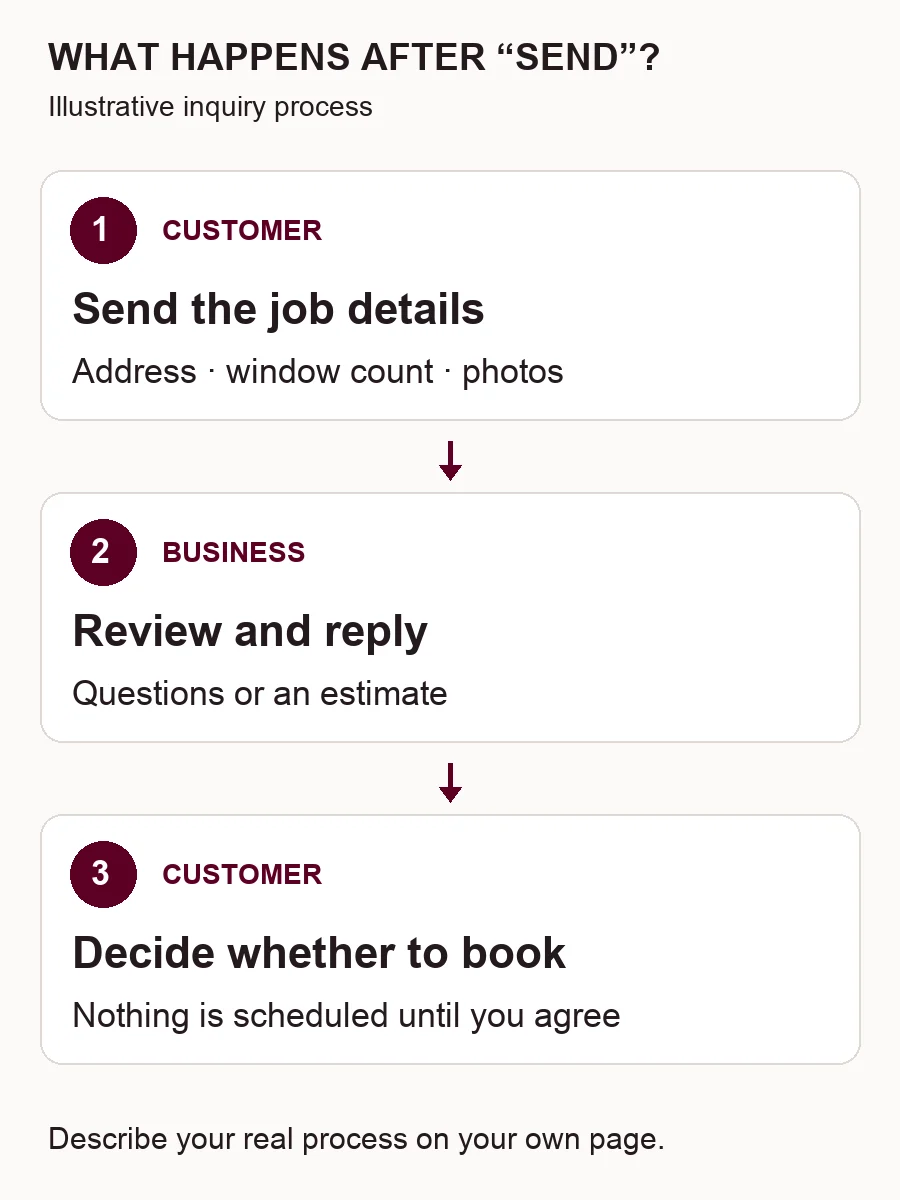
Stronger: “Send your address, your window count and a photo. We’ll review it and reply with questions or an estimate. Nothing is scheduled until you say yes.”
Check 6: Is the next step obvious?
Visitors are at different stages. Some are ready to ask for an estimate. Others want a question answered first, or want to see an example. Match the action to their readiness: review an example, ask a question, or request information, through a route that really exists and that you monitor.
Label the action clearly. The reader should know whether they are asking a question, requesting an estimate or booking work.
Weak: “Contact us today.”
Stronger: “Ask a question, or request an estimate,” with each route explained.
See it in action: before and after
Consider a residential window-cleaning service page.
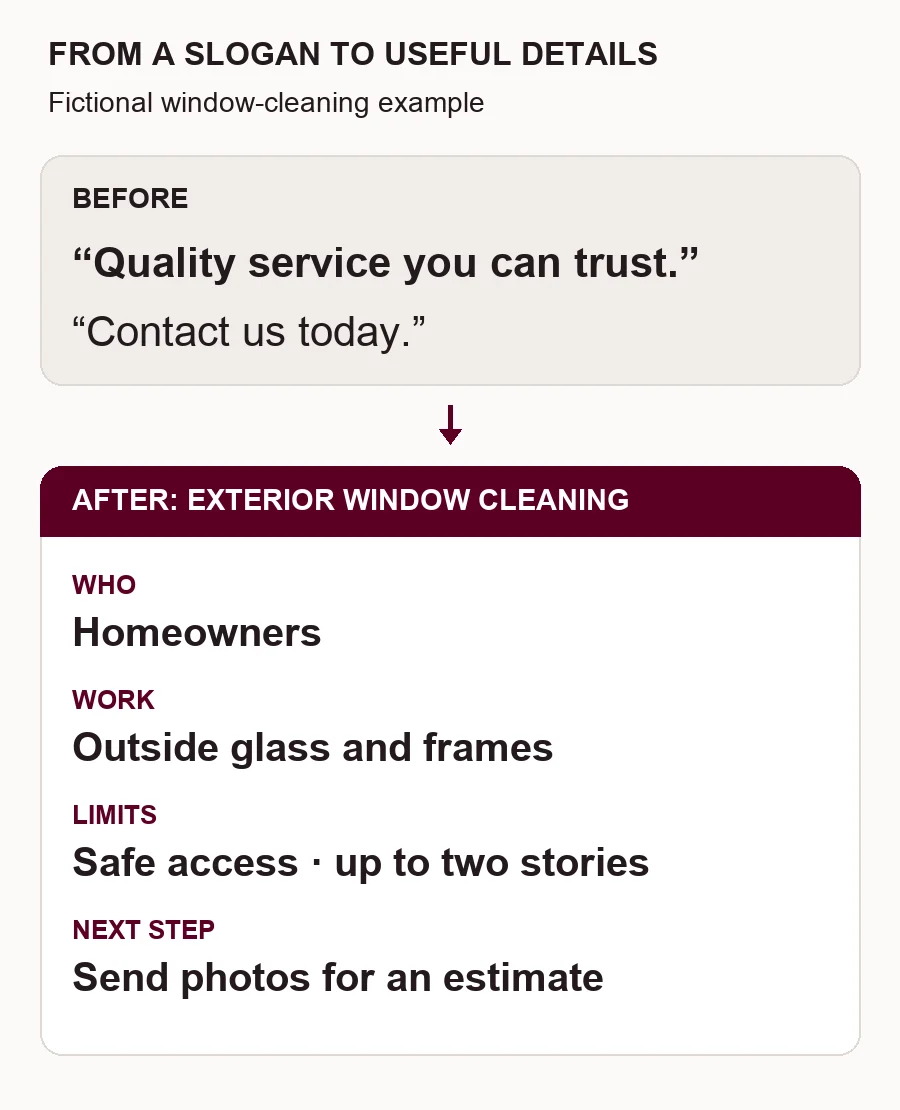
Before
Quality service you can trust. Contact us today.
The copy gives you little to judge. It does not identify the work, service area or what happens after an inquiry.
After
Exterior window cleaning for homeowners
Who this is for: Homeowners with single-family houses whose outside windows have built-up dirt, pollen or water spots, and who want them cleaned once or on a regular basis.
What we do: We clean the outside glass and frames of windows we can safely reach, up to two stories. Interior windows can be added to your estimate.
How we estimate: The window count, number of stories, access and condition affect the quote. Tell us whether you want interior windows included. We confirm the scope and price before you decide whether to book.
What we don’t do: We don’t repair damaged glass or seals, remove paint or construction residue, or clean windows we can’t reach safely. Some mineral stains or etched glass may not come fully clean, and we’ll tell you what we see before work begins.
Where we work: Homes in Maple Grove and Cedar Falls. Outside those towns, ask us whether we can travel.
What happens when you contact us: Send your address, an estimate of how many windows you have, how many stories the house has, and a photo of the front and back. We review it and reply with questions or an estimate. Nothing is scheduled until you say yes.
Ready? Use the request form to ask for an estimate, or call to ask a question first.
Notice what changed: a visitor can judge the fit, understand the scope and pricing process, and see what happens next. The revised page helps someone decide whether to ask for an estimate.
To strengthen the page, add a work example you have permission to share, genuine reviews or relevant qualifications. Clear wording helps people understand the offer; it cannot replace evidence of the work.
The checklist: run it against one page
Answer each line yes, partly or no.
1. Fit
- ☐ The page names who the service is for.
- ☐ It describes the situation or problem in plain words, not just a slogan.
2. Service and boundaries
- ☐ It names the specific work covered.
- ☐ It states a price or explains what affects the estimate and when the customer can decide.
- ☐ It states relevant exclusions or limits.
- ☐ It distinguishes the work offered from results that depend on conditions.
3. Geography and delivery
- ☐ It lists actual towns, counties or regions served, or states how remote work is delivered.
- ☐ It says how to ask about places or situations outside your usual area.
4. Evidence
- ☐ It shows at least one real, evaluable item: an authorized work example, a relevant credential you actually hold, or a genuine review.
- ☐ Claims about the business are accurate and supported.
5. Inquiry process
- ☐ It describes the real first step after contact.
- ☐ It tells the visitor what information to have ready.
- ☐ It explains how the next decision is made, without a response-time promise you can’t keep.
6. Next step
- ☐ There’s an obvious action that matches the reader’s readiness.
- ☐ The route to take that action is real and monitored.
Count your “partly” and “no” answers. Don’t try to fix them all at once. Find the one that would be hardest for a stranger to answer from your page, and start there.
Common questions
Do I have to list prices?
If a fixed price would be misleading, explain what affects the estimate, what information you need and when the customer can decide.
Do all six checks belong on every page?
Answer the questions that matter on that page and link clearly to shared information such as service areas or work examples. Keep the facts consistent wherever they appear.
What if my honest answer is “it depends”?
Say what it depends on. “It depends,” with the factors named, is an answer. A bare “it depends” isn’t.
Your next step: choose one page, run six checks, fix one answer
Start with the answers you can improve on the current page. A clearer description of the work or the first step gives you a practical place to begin.
- Choose one page that a prospective customer is likely to see.
- Work through the six checks above.
- Rewrite the answer that is hardest to find. Make it plain, specific and true.